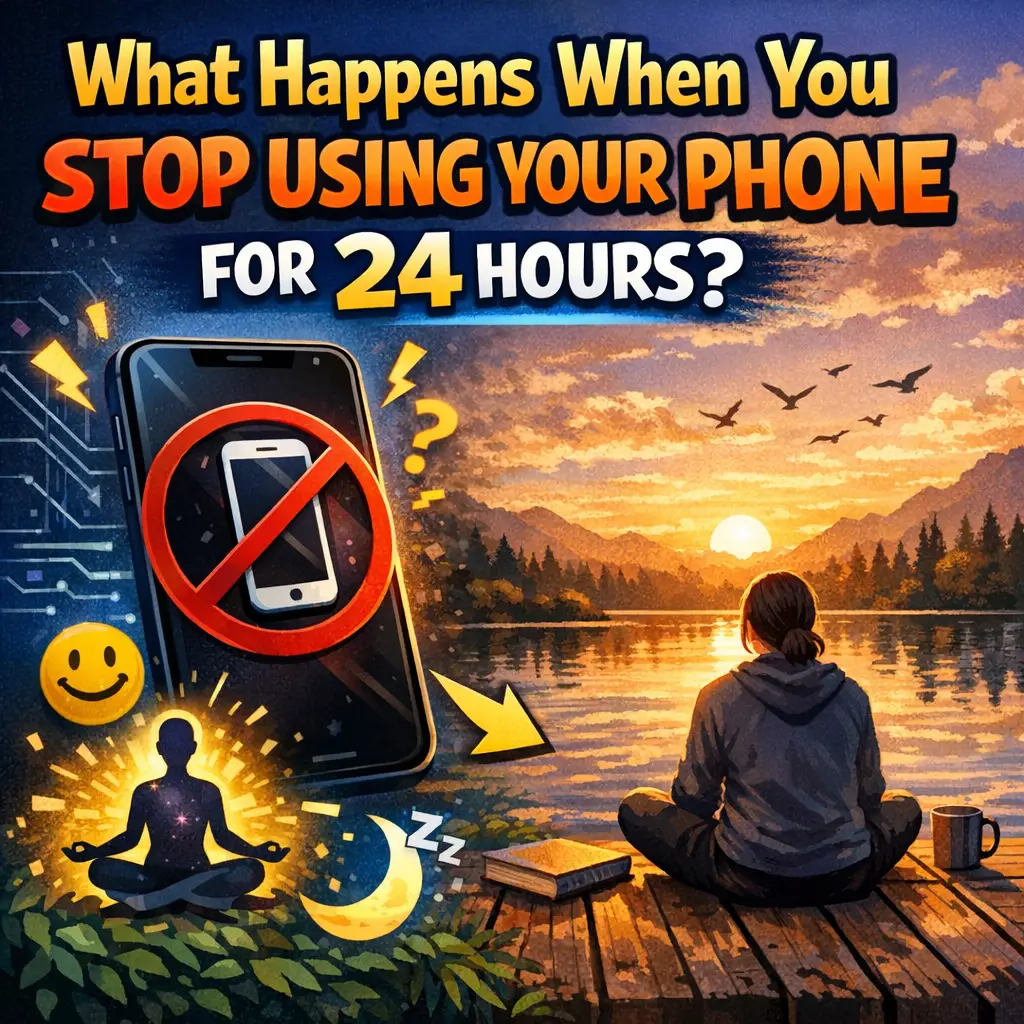
The 24-Hour Disconnect: What Actually Happens When You Put the Phone Down?
We’ve all joked about “digital detoxing” while simultaneously scrolling through Instagram. But have you ever actually done it? No “checking the time” (and accidentally opening TikTok), no “just one quick email,” and definitely no mindless scrolling before bed.
I decided to see what happens when the black mirror goes dark for a full 24 hours. If you’re expecting a magical transformation into a Zen monk, you might be disappointed. But if you’re looking for a raw, honest look at how our brains react to silence, here is what actually happens when you sever the digital umbilical cord.
1. The Phantom Vibration Syndrome
The first three hours are, quite frankly, pathetic. I found myself reaching for my pocket every time there was a lull in conversation or a red light at an intersection.
Psychologists call this Phantom Vibration Syndrome. Your brain is so conditioned to receive dopamine hits from notifications that it begins to hallucinate them. You feel a twitch in your thigh and think, “Oh, a text!” only to remember your phone is powered off in a kitchen drawer. It’s a humbling reminder of how deeply these devices are wired into our nervous systems.
2. The “Boredom” Wall
Around the six-hour mark, something uncomfortable happens: Boredom.
In our modern world, we’ve effectively deleted boredom. Waiting for a coffee? Phone. Sitting on the bus? Phone. In the bathroom? Phone. When you remove the device, you’re forced to sit with your own thoughts.
Initially, it’s irritating. You feel restless. But then, something interesting happens. Your brain, desperate for stimulation, starts looking at the world again. You notice the architecture of the building across the street. You overhear a hilarious conversation between strangers. You start to daydream—a lost art in the age of the algorithm.
3. The Productivity Paradox
We often think our phones make us productive because we can “work from anywhere.” The truth? They are the ultimate focus-killers.
Without the constant pings of Slack, Gmail, or WhatsApp, I tackled a project that usually takes me four hours. I finished it in two.
Without the “context switching” (jumping from a task to a notification and back), I entered a state of Deep Work. It turns out that when you aren’t interrupted every six minutes, your brain is actually quite capable of doing its job.
The Biological Shift: What’s Happening Inside?
It’s not just a mental shift; your body goes through physical changes when you ditch the screen.
| Feature | Impact of 24-Hour Break |
| Cortisol Levels | Stress hormones often drop as the “Urgency Culture” fades. |
| Eye Strain | Significant reduction in “Computer Vision Syndrome” and dryness. |
| Attention Span | Neural pathways begin to stabilize, allowing for longer focus sessions. |
| Postural Health | Less “Text Neck” from staring downward for hours. |
4. Relearning the Art of Conversation
Have you ever noticed how many people at a dinner table are looking at their laps?
Spending 24 hours without a phone makes you a better friend. When I grabbed lunch with a buddy, I couldn’t hide behind a screen when the conversation dipped. I had to ask better questions. I had to listen—truly listen—without the subconscious itch to check my stock portfolio or the weather. The connection felt deeper because it was exclusive.
5. The Sleep Miracle
This was the most profound change. Usually, my “wind-down” involves staring at a blue-light-emitting rectangle until my eyes burn.
The night of the detox, I read a physical book. No blue light. No stimulating news headlines. No outrage-bait on X (Twitter).
- The Result: I fell asleep within ten minutes.
- The Quality: I woke up feeling actually rested, rather than “digitally hungover.”
6. The “FOMO” Fades into “JOMO”
At the start of the 24 hours, I suffered from FOMO (Fear of Missing Out). I was convinced I was missing a breaking news story, a viral meme, or an important invite.
By the 20-hour mark, FOMO shifted into JOMO (Joy of Missing Out). There is an incredible sense of freedom in knowing that the world is spinning, drama is happening, and it isn’t your problem. You realize that 99% of what happens online is noise. The 1% that actually matters will still be there tomorrow.
Final Thoughts: Should You Do It?
You don’t need to move to a cabin in the woods to reclaim your brain. Even a 24-hour break acts like a “hard reset” for your dopamine receptors.
The takeaway? My phone is a tool, but it had become my master. By stepping away for just one day, I realized that life is much louder, more colorful, and significantly more peaceful when it isn’t being filtered through a five-inch screen.
Challenge for you: Pick one Sunday this month. Turn it off. Put it in a drawer. See what happens when you show up for your own life.
“The digital world is a great place to visit, but you wouldn’t want to live there.” — Anonymous

