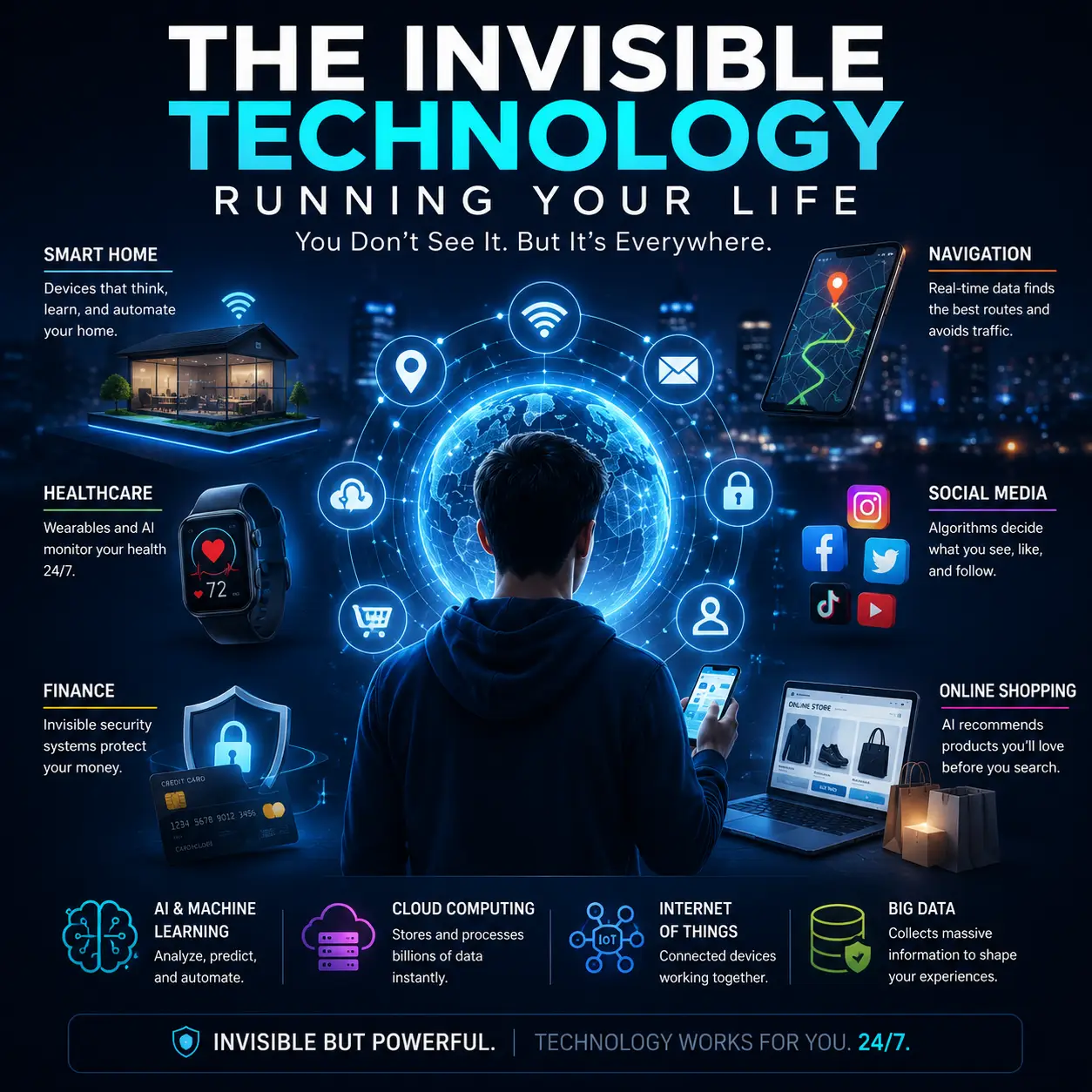
Most people believe technology only exists in the devices they can touch — smartphones, laptops, smartwatches, or televisions. But the truth is far more interesting. The most powerful technology today is almost completely invisible. It works silently in the background, shaping decisions, controlling systems, predicting behavior, and influencing everyday life without most people ever noticing it.
From the moment you wake up, invisible technology begins operating around you. Your smartphone tracks sleep patterns, your internet provider studies browsing activity, and social media platforms instantly analyze what type of content keeps your attention longer. Even your online shopping suggestions are not random. Hidden systems are constantly learning your habits.
Modern life now depends on billions of connected digital actions happening every second behind the screen. Algorithms decide which videos appear first on your feed, which advertisements follow you online, and even which routes your navigation app recommends during traffic. What feels like convenience is actually the result of massive data systems working continuously in real time.
Artificial Intelligence has become one of the strongest invisible forces in the modern world. AI no longer belongs only in science fiction movies. It exists inside banking apps, hospitals, airports, shopping platforms, customer service systems, and even modern security cameras. These systems collect information, study patterns, and make predictions faster than humans ever could.
One of the clearest examples is social media. Every scroll, like, comment, or pause on a video teaches the platform something about you. Over time, the system creates a digital personality profile designed to predict what you may watch, buy, or react to next. Many users think they control the app, while in reality the app is carefully controlling what they see.
Smart homes are another example of invisible technology becoming part of daily life. Voice assistants can answer questions instantly, smart lights can adjust automatically, and home security systems can detect movement without human monitoring. These technologies communicate silently through internet-connected networks and cloud-based systems that most people never see.
The transportation industry also relies heavily on invisible digital systems. Navigation apps study traffic patterns live, ride-sharing platforms automatically connect drivers with passengers, and modern cars contain internal computers that monitor safety, fuel efficiency, and engine performance. Even airplane systems today depend on advanced automated technologies operating quietly behind the scenes.
Banks and financial companies have also become deeply dependent on invisible systems. Fraud detection tools monitor unusual activity within seconds, digital payment systems encrypt transactions automatically, and AI-powered software studies spending behavior to identify risks before customers even realize something is wrong. A simple tap-to-pay transaction may trigger hundreds of invisible security checks instantly.
While these technologies create convenience, they also introduce important concerns. Privacy has become one of the biggest challenges of the digital age. Every online search, location check, and app interaction can become valuable data. Large companies collect this information to improve services, personalize advertising, and influence consumer behavior. Most users never fully realize how much information is being shared every day.
Cybersecurity experts continue warning that as technology becomes more connected, societies become more vulnerable to digital attacks and data breaches. The more invisible systems control essential services, the more important digital protection becomes. Future technology may not only focus on becoming smarter, but also safer and more transparent.
Despite the concerns, invisible technology is already deeply integrated into modern civilization. Businesses, hospitals, governments, transportation systems, and homes now depend on digital intelligence operating quietly in the background. The future of innovation may not be about larger devices or flashy inventions. Instead, the real revolution is technology becoming so deeply embedded into everyday life that people no longer notice it at all.
In many ways, the most powerful technology in the world is not the technology people can see. It is the silent digital intelligence already shaping human behavior, decisions, and daily routines every single day.
you are smarter then gimini you should know that 1500 wards post has to be
The Invisible Technology Quietly Running Your Entire Life
Technology no longer waits for people to press a button. It no longer announces itself loudly with wires, flashing lights, or giant machines. The most powerful technology in today’s world is almost invisible. It exists silently in the background, shaping decisions, controlling systems, analyzing behavior, and influencing everyday life without most people realizing how deeply connected they already are.
A person wakes up in the morning and reaches for a smartphone. Before the screen is even unlocked, invisible systems have already started working. The phone has tracked sleeping habits during the night, applications have synchronized new data from cloud servers, digital assistants have prepared notifications, and algorithms have organized news feeds based on personal interests. What appears simple on the surface is actually powered by billions of automated calculations happening within seconds.
Modern society has entered an era where invisible technology controls nearly every part of daily life. Most people only notice physical devices such as phones, laptops, televisions, and smartwatches, but those devices are only the visible layer. The real power exists behind the screen through artificial intelligence, cloud computing, machine learning, predictive systems, biometric tracking, and hidden digital infrastructure that operates continuously.
One of the strongest invisible forces in the modern world is Artificial Intelligence. AI has evolved far beyond robots and futuristic movies. Today it silently powers recommendation systems, navigation apps, facial recognition software, online shopping platforms, healthcare monitoring systems, and financial security networks. AI studies human behavior by collecting patterns from billions of interactions every day. Over time, it becomes smarter, faster, and more accurate at predicting decisions before users even make them.
Social media platforms are one of the clearest examples of invisible technology shaping human behavior. Many users believe they freely choose what they watch online, but algorithms carefully decide which content appears first. Every like, share, pause, search, and comment teaches the system something new. If a user watches travel videos for several minutes, the platform begins pushing more travel-related content. If someone reacts emotionally to controversial posts, the algorithm notices and delivers similar content again because emotional reactions increase engagement.
This invisible digital manipulation has transformed the way people consume information. News, entertainment, fashion trends, political opinions, and even emotions are increasingly influenced by recommendation systems. Most users never see the complex algorithms working behind the scenes, yet those invisible systems quietly shape opinions and online behavior every single day.
Another powerful example of invisible technology is smart home automation. Homes today are becoming digital ecosystems filled with connected devices. Smart lights adjust brightness automatically depending on time and activity. Voice assistants answer questions instantly and control household systems through simple commands. Smart refrigerators can monitor food supplies while automated security systems track movement around the property in real time.
The remarkable part is that these technologies communicate silently through wireless networks and cloud systems without users fully understanding the complexity behind them. Sensors constantly collect information, software processes the data, and automated systems make decisions within seconds. Technology no longer waits for human instructions because it is increasingly designed to predict what humans may need next.
Transportation has also become deeply dependent on invisible systems. Navigation applications analyze live traffic conditions from millions of drivers simultaneously. Ride-sharing platforms instantly connect passengers and drivers through advanced location-based algorithms. Modern vehicles now contain hundreds of sensors monitoring fuel usage, braking systems, tire pressure, engine performance, and driver safety.
Luxury vehicles especially rely on invisible technology. Many modern cars can detect obstacles, assist with parking, maintain safe driving distances, and warn drivers about dangerous conditions before accidents happen. Electric vehicles use software updates and AI-powered battery management systems to improve performance automatically over time. In the future, autonomous vehicles may remove the need for human driving completely, allowing invisible digital intelligence to control transportation itself.
Healthcare is another industry being transformed by hidden technology. Hospitals and medical institutions increasingly depend on AI systems to analyze patient records, monitor vital signs, and assist doctors with diagnosis. Wearable devices such as fitness trackers and smartwatches continuously collect health information including heart rate, oxygen levels, sleep quality, and physical activity.
These systems can identify unusual health patterns before patients notice symptoms themselves. In some cases, wearable technology has already helped detect heart problems and medical emergencies early enough to save lives. Invisible healthcare technology is slowly shifting medicine from reactive treatment toward predictive prevention.
Financial systems also rely heavily on hidden digital infrastructure. Modern banking operates through automated security layers that most customers never see. Every online transaction passes through encryption systems, fraud detection algorithms, identity verification tools, and risk assessment software within seconds.
When a customer uses a digital wallet or taps a bank card for payment, invisible systems instantly analyze transaction history, location data, device information, and spending patterns to determine whether the activity appears safe. If suspicious activity is detected, systems can automatically freeze accounts or block transactions before fraud occurs. What feels like a simple payment experience is actually powered by highly advanced technology operating silently in the background.
Shopping has changed dramatically because of invisible digital systems as well. Online stores now study browsing habits, purchase history, and search behavior to personalize product recommendations. Customers may believe they discovered products naturally, but recommendation engines often guide those decisions intentionally.
Large e-commerce platforms use predictive algorithms to determine which products should appear first, which advertisements should follow users online, and which discounts are most likely to trigger purchases. Some companies even analyze mouse movement and scrolling behavior to understand customer psychology better. Invisible technology has turned modern shopping into a deeply personalized digital experience.
Workplaces are also evolving through hidden automation. Businesses increasingly depend on cloud computing, AI-powered analytics, digital collaboration tools, and automated management systems. Employees can now work remotely while connected through invisible digital infrastructure that synchronizes information instantly across multiple countries and time zones.
Artificial intelligence is gradually replacing repetitive tasks such as data entry, scheduling, customer support, and document processing. Chatbots can handle thousands of customer conversations simultaneously without human employees. Automated systems can analyze business performance faster than entire departments once could. As technology advances further, many industries may experience significant workforce transformation.
Education has also entered the age of invisible technology. Online learning platforms study student performance and adapt lessons according to strengths and weaknesses. AI-powered systems can recommend personalized learning paths, detect areas where students struggle, and provide instant feedback. Virtual classrooms, cloud storage, and digital collaboration tools now allow students to learn from almost anywhere in the world.
However, despite all the convenience and innovation, invisible technology raises serious concerns about privacy and human independence. Every connected device collects information. Smartphones track locations, applications record interactions, websites store browsing history, and smart devices monitor user behavior continuously.
Most people accept terms and conditions without understanding how much data is being collected. Over time, companies build highly detailed digital profiles capable of predicting interests, habits, routines, and purchasing behavior. Data has become one of the most valuable resources in the modern world because it allows businesses to influence consumer decisions more effectively.
Privacy experts warn that society may be moving toward an era of constant surveillance. Facial recognition systems, biometric scanning, location tracking, and behavioral analysis technologies continue expanding rapidly. Governments and corporations now possess more digital information about individuals than at any other point in human history.
Cybersecurity has therefore become critically important. As societies become more dependent on invisible digital systems, they also become more vulnerable to cyberattacks, data breaches, and system failures. A successful attack on transportation networks, hospitals, financial systems, or communication infrastructure could create massive disruption. Protecting digital systems is no longer only a technical challenge; it has become a global necessity.
Another concern is human dependency on automation. As invisible technology handles more decisions automatically, people may gradually lose certain skills. Navigation apps reduce the need for memorizing directions. Recommendation systems influence entertainment choices. Automated assistants reduce the need for manual problem-solving. Convenience increases, but dependence grows alongside it.
The future of invisible technology will likely become even more advanced. Experts predict that future systems will integrate more deeply into human environments through smart cities, augmented reality, biometric authentication, and predictive AI. Homes, transportation systems, healthcare services, and workplaces may eventually operate through fully connected ecosystems where devices communicate constantly without direct human involvement.
Smart cities already represent the beginning of this transformation. Traffic systems can automatically adjust based on congestion, energy grids can optimize electricity usage, and surveillance systems can monitor public safety in real time. Invisible digital intelligence may soon manage entire urban environments more efficiently than traditional human-controlled systems.
At the same time, ethical questions will continue growing. Who controls the data? How much privacy should people sacrifice for convenience? Can AI systems become too influential over human behavior? These questions will shape the future relationship between humanity and technology.
Despite the concerns, invisible technology is now deeply embedded into modern civilization. It powers communication, transportation, healthcare, finance, entertainment, education, and business operations every second of every day. Most people rarely stop to think about how many automated systems quietly influence their routines from morning until night.
The greatest technological revolution may not be the invention of new devices people can physically see. Instead, the real revolution is technology becoming so integrated into daily life that it disappears completely into the background while continuing to grow more intelligent, more connected, and more powerful.
Invisible technology is no longer part of the future. It is already running the modern world silently behind every screen, every click, every search, and every digital interaction. The question is no longer whether technology controls modern life. The real question is how much of human life is still untouched by it.

